Revise & resubmit, American Economic Review · read the paper ↗
At the time of the French Revolution, most of France did not speak French. A century later, it did. This is the story of how classrooms — opened by an accident written into two laws — taught a country its language, and of the quieter puzzle underneath: why the villages said yes.
This is not French. It is Provençal — one of the many languages of France, and the everyday speech of much of the south well into the nineteenth century. Shown here is the opening page of Mirèio (1859), a book-length poem by Frédéric Mistral. He had to publish it with a French translation, because most readers of French could not understand it.
Mistral, a farmer’s son from a village near Avignon, spent his life writing in the language his neighbors spoke — and compiling its dictionary. In 1904, Mirèio won him the Nobel Prize in Literature: still the only Nobel ever awarded for work in a language recognized by no state. He spent the prize money on a museum of Provençal life, in Arles.
This page tells the story of how languages like his gave way to French — and of the two laws, passed in the 1830s, that set the change in motion.
In 1794, Father Grégoire reported to the revolutionary Convention on the languages of France: “we are still, for language, the Tower of Babel.” By his count, only three million of twenty-nine million citizens spoke French fluently. The map below is what he was describing — not regional accents, but more than forty languages and dialects, some as far from French as Spanish is.
The north spoke the langues d’oïl — the family that contains French, which grew out of the dialect around Paris. The south spoke Occitan, the language of the troubadours, closer to Catalan than to French. Between them, Francoprovençal; at the edges, Breton, Basque, Catalan and Flemish.
Within each family, a mosaic: Picard, Gascon, Provençal, Limousin, Auvergnat… Hover the map to name them. These are the historical dialect areas from the Carte linguistique de la France — the same boundaries the paper uses.
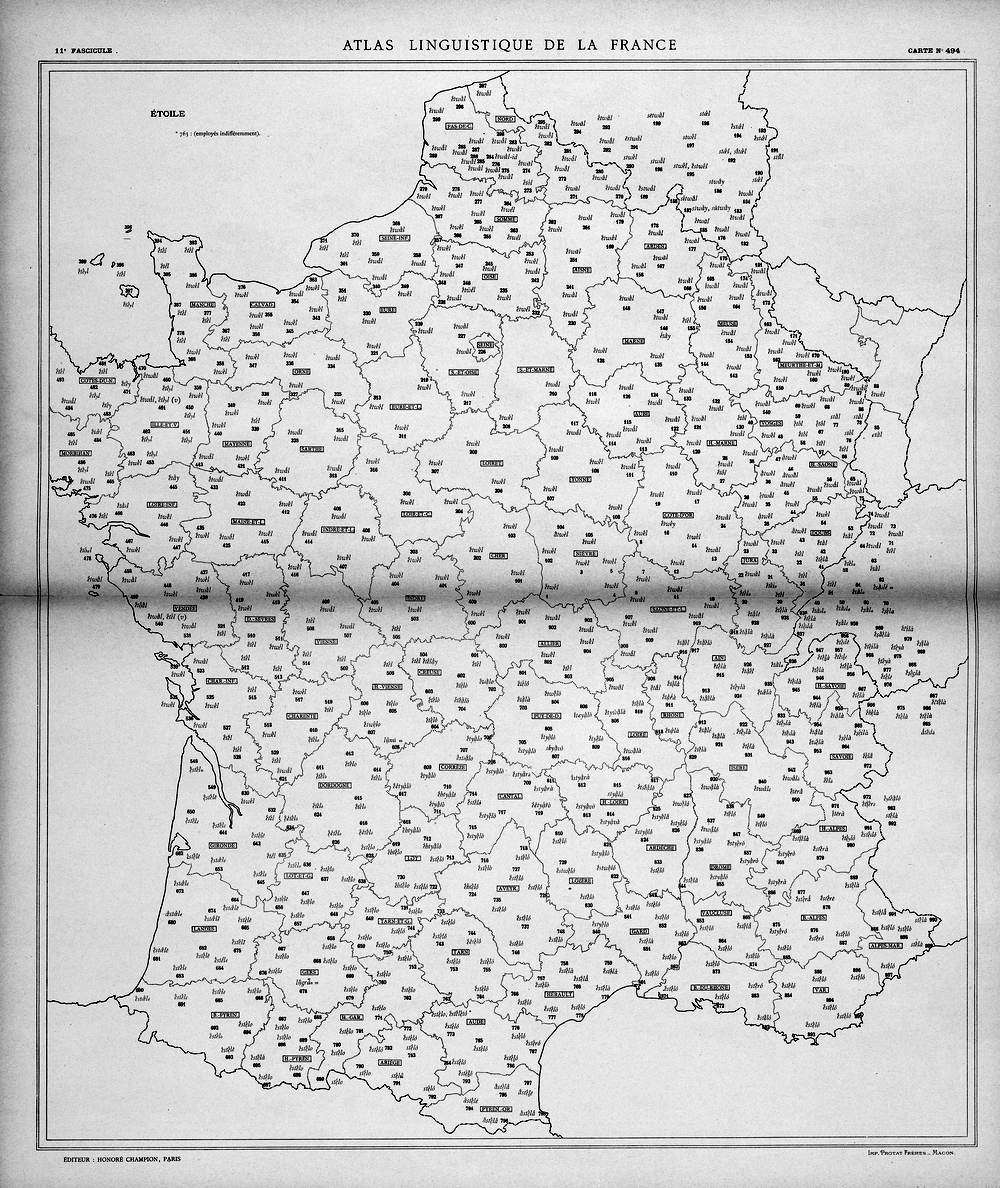
A map of borders shows where the languages lived — not what they sounded like. For that, the paper leans on one of the strangest and most heroic surveys ever made: the Atlas linguistique de la France, conceived and directed by the linguist Jules Gilliéron. From 1897 to 1901 his fieldworker — Edmond Edmont, a grocer with a famously sharp ear — travelled from village to village with a questionnaire, sat down with locals, and wrote out, sound by sound, how they said 1,920 everyday words. Gilliéron then printed one map per word: all of France, with each village’s pronunciation at its location.
Up close, each sheet is a lattice of phonetic script: beside every village’s number, the exact local form of one word. The paper digitizes 50 of these sheets — everyday words like star, water, moon, night — entry by entry, for all 577 villages.
Below, browse all fifty: the sheet as printed on the left and, on the right, what it becomes once measured.
Each sheet is one word, exactly as Gilliéron printed it: a phonetic entry beside each of the 577 villages Edmont visited — here, étoile, “star.” Pick any of the 50 words; the sheet changes with it.
Keep scrolling, and the print dissolves into the measure: each village’s area shaded by how far its recorded form sits from the one near Paris, counted sound by sound. Hover the villages to read the raw entries; pick other words — ciel, eau, lune…
Now average the sound-by-sound distance across all 50 sheets, village by village, and you get the paper’s outcome: linguistic distance from French in 1900. Darker means farther from French. The south is another country.
This is the number the whole paper tries to move.
“The Third Republic found a France in which French was a foreign language for half the citizens.” Eugen Weber, “Peasants into Frenchmen” (1976)
Nothing above happened by accident, and none of it began with the Republic’s famous school laws of the 1880s. It began fifty years earlier, after the Revolution of 1830 put a constitutional king, Louis-Philippe, on the throne. The new regime — the July Monarchy — passed two laws in quick succession that would quietly remake the countryside.
Under the restored Bourbons, the town hall of a small commune belonged to a few families. A prefect wrote in 1835 of villages where the councillors “are all relatives or allies”; in one commune, villagers still called it “the council of families” in the 1960s. The Municipal Law of 1831 introduced local elections everywhere — but only in communes above 500 inhabitants did it also ban relatives from sitting together on the council, and enlarge the council from ten seats to twelve. Above the line, the old families lost their lock on the town hall. Below it, they kept it.
Two years later, François Guizot’s education law told every commune to maintain a primary school for boys, teach in French from state-approved textbooks, and hire teachers trained in the new écoles normales. But there was a catch: the commune itself had to vote the money.
Each school is “a colony of French language in a conquered land.” Pierre Lorain, adviser to Guizot, 1837
Guizot’s law was written for every commune — historians and archive inventories have long described it as applying above 500 inhabitants, a threshold the paper traces to the Municipal Law’s politics rather than the education law itself. What matters here is the chain: where the 1831 law had broken the old families’ grip, the 1833 school money passed; where it hadn’t, it often didn’t. Guizot himself counted “21,000 municipalities that do not feel the need for primary instruction.”
A sharp line at 500 inhabitants is a gift to a researcher. Villages of 480 and 520 people were alike in everything — fields, church, patois — except which side of the line they fell on. Compare them, and whatever differs afterward is what the laws did. Economists call it a regression discontinuity; you can simply call it twin villages.
If the story is right, the paper trail should show it twice over: first a wave — schools surging the moment the law passes — and then a chain of jumps at 500, in who governs, in votes, in schools, in textbooks. The authors dug the records out of departmental and national archives, commune by commune. Scroll, and watch the wave break — then each link of the chain snap into place.
First, the raw archives. In 1879, prefects in Gard, Marne and Oise tabulated the opening year of every public school in their departments — three centuries of records. The tallest bar of all is 1834, the first full year of the Guizot Law; the 1833–47 window holds 27% of every school ever opened. Hover the bars.
The same wave shows in national statistics: public schools per thousand inhabitants jump by half again between 1834 and 1837 — the sharpest move on record — and literacy, under one adult in two when the law passed, nears universal by the 1890s.
But a wave alone can’t separate the law from the times. For that, the twins.
After 1831, communes just above the line were 7 points less likely to be run by a mayor from the old pre-1831 families — against roughly 30% below the line. Crowdsourced lists of 248,367 mayors, 1793–1913.
Run the same comparison year by year and the break appears at 1831, not before — largest during the July Monarchy itself, fading over the century as the old dynasties died out everywhere.
In late 1833 every council had to vote funds for its school. Below the line, roughly one commune in five voted “insufficient” or refused. Just above, the refusal rate is 16 points lower — cut roughly in half. Prefects’ tallies, seven departments.
Between 1833 and 1847, communes above the line were 18 points more likely to open a public school — and among communes with no school at all before Guizot, the gap is 53 points. School registers of Gard, Marne and Oise.
Inside the schools, the approved French primer — the Alphabet et premier livre de lecture — shows up 10 points more often above the line. Language, by the book, from Paris.
The paper’s Figure 3, re-estimated here from the replication data: population piles up on neither side of the line (Panel A; bias-corrected density test p = 0.67 in the Atlas, 0.13 in France), and linguistic distance predicted from everything measurable before 1833 — geography, institutions and culture, the economy — is dead flat at 500 (Panels B–D). Its Figure 9 repeats the exercise with public goods that arrived after 1833 — cadastre, post offices, roads, railways — and finds the same nothing: the school reform is the only policy that turns on at the line.
Now the payoff. The schools open in the 1830s; the Atlas listens in 1900, two generations later, to what people actually speak at home — not what children recite in class. Put the 577 Atlas villages on the same twin-villages scale, and peel the onion one layer at a time.
Every Atlas village by its 1836 population; height is distance from French in 1900. A cloud. Raw comparisons mislead — bigger villages sat farther from Paris, and the south has fewer villages near the line.
Average the villages into groups of similar size and fit a curve on each side. A gap opens at 500: −0.09. But the raw gap comes with wide uncertainty.
Now compare villages within the same department and the same historical dialect, at the same distance from Paris — the specification behind Figure 10 of the paper. The gap sharpens: −0.10 (s.e. 0.02). One administrative line, ten points of language.
Relative to the villages just below the line, that is a 20% head start on the road from patois to French — a lower bound on how much faster treated villages homogenized between 1833 and 1900. It covers more than a quarter of the gap between a typical southern and a typical northern village.
Re-run the whole exercise pretending the law’s line sat at 300, 310, … 700. Drag the slider when the chart is free. Only the true line produces the jump.
Measure population in any other decade of the century instead of 1836. The jump appears only around 1831–1836 — when the two laws bit. Across 400+ placebo regressions on every outcome in the paper, 95% of true-threshold estimates are significant, against 9% at fake lines and 9% in fake years.
One last turn of the dial — and the most beautiful. Instead of moving the line or the year, change what counts as “French”: recompute every village’s linguistic distance using each of the 577 Atlas towns in turn as the reference, and re-run the whole experiment each time. If the schools were teaching the elites’ French, villages above the line should converge only toward the speech of the places where that French was actually spoken.
Here is the uncomfortable beauty of the result: school was never compulsory under Guizot. The state opened a door and stocked it with its primer; families chose to walk through — and the Atlas shows they brought the language home. Two clues say why.
The jump in French is about three times larger where Enlightenment-era book buyers had lived — the local notables who ran the new councils — and where the demand for schooling was surging and the railway was about to arrive. It is no larger in richer places than poorer ones: this was not wealth buying assimilation, but elites who believed in schooling and families for whom reading had started to pay.
Split the measure into words and accent. In the Occitan south, villages above the line use +29 points more French vocabulary — a language shift — while pronunciation, if anything, drifts slightly apart: they took the words and kept the accent, with a whisper of defiance in the vowels. In the oïl north, where the words were already French cousins, it is pronunciation that quietly converges.
The language carried an identity with it, and the identity outlived everyone in this story. A century after Guizot, villages just above the old line produced more Resistance heroes and fewer Nazi collaborators during the Occupation, and in 1969 voted more heavily to keep France one and indivisible. The paper calls these results suggestive — smaller samples, wider bands — and so should you; they are the shadow of the effect, not its proof.
The languages paid the bill. Stendhal saw it coming in 1838: “All nuances are constantly disappearing in France. In fifty years, there may not be any Provençals or Provençal language.” The Provençal of Mirèio, from the top of this page, is now endangered — like nearly every language on the first map.
France was not born French. It was schooled into it — by two laws that broke the village dynasties, a state primer, and families who wanted their children to read. Consent did the work coercion could not; the price was paid in languages.
The estimates are local to villages near 500 inhabitants and capture the bundle of the two July Monarchy Laws — new councils plus state-sponsored education — not the school alone. The language result rests on the 577-village Atlas, with roughly 40–133 villages in the estimation window; hence the paper’s reliance on visual evidence, many specifications, and its wall of placebos. Every figure on this page was re-computed from the paper’s replication data and code with the published specifications; the persistence results are suggestive, and labeled as such.